

Moissanite doesn't get cloudy, and it doesn't tarnish. If your chain looks flatter than the day you unboxed it, something around the stones has changed: skin oil on the facets, the gold finish on the metal, or the tiny claws holding each stone. On an iced-out chain, all three show up sooner than on a single ring.
Does Moissanite Get Cloudy?
No. Moissanite is silicon carbide, about as chemically stubborn as anything you can wear. Water, sweat, soap and household cleaners do not react with it at any temperature your jewelry will see. With a hardness of 9.25, one step under diamond, it holds up to keys and zippers in normal wear. Nothing inside the stone turns it milky with age.
Why do people swear theirs went cloudy, then? Almost always, it's a film. Like diamond, moissanite is lipophilic, meaning grease clings to its surface more readily than water does. Skin oil, lotion, cologne and soap residue build a thin layer over the facets, and light that should bounce back out of the stone gets scattered on the way. Under a lamp the layer can even throw a faint rainbow sheen, the "oil slick" look people post photos of. Wash it off and the stone looks the way it did the day it arrived.
Which makes for an easy test. Give it a proper clean, and if the sparkle comes back, the film was the whole story. Hardness, fire and price sit side by side on our moissanite vs diamond comparison. The question here is narrower: what changes after months of wear, and what doesn't.
Does Moissanite Tarnish?
The stone does not. Tarnish is a reaction on the surface of a metal, and silver mostly tarnishes when it meets sulfur compounds in the air. Moissanite is not a metal, so there's nothing on it to react. What can tarnish is the metal it's set in.
Most of what we sell is 925 sterling silver under a white, yellow or rose gold finish. Sterling is 92.5% silver with the rest mostly copper, and left bare it slowly darkens. The plating sits on top as a barrier and gives the piece its color. While that layer is intact, the silver underneath stays out of contact with air and skin. Where it thins, usually at the spots that rub, the silver starts to show and can darken over time.
Solid 10K and 14K gold behave differently, because the karat runs all the way through and there's no layer to wear down. Lower karats carry more alloy and can dull slightly at the surface, but a polish brings them back rather than exposing a different metal underneath.
Why an Iced-Out Chain Looks Dull Before a Solitaire Does
A single stone on a ring has one table and a handful of facets to keep clean. A fully iced Cuban link has hundreds of small stones set edge to edge, and every gap between them is somewhere for oil and dust to settle. Nothing about those stones is different from the solitaire, but there is far more surface to keep clean, and much of it sits where a cloth can't reach.

I kept running into this gap while researching the guide. Most of the jeweler articles on the first page for these questions were written with an engagement ring in mind, and very little of their advice deals with an iced-out chain, which is what most people shopping here actually wear.
A chain also lives somewhere rougher than a finger. It rests against your neck all day, picking up sweat, collar friction and whatever you sprayed on before leaving the house, and unlike a ring it never gets a rinse when you wash your hands. The back of each link sits on skin, and where the settings are closed behind the stones, grime has no easy way out. Open settings can be cleaned from behind. Closed ones just take more patience with a soft brush.

Turn an iced Cuban over and this is the side that touches your skin: smooth, solid metal on the inside of every link. On a plated piece, that inner curve is one of the spots where the finish takes the most rubbing.
A chain that looks flat after a couple of months of daily wear usually just needs a proper wash.
How Long Does Moissanite Last?
Longer than everything around it. You can lift a stone out of a tired setting, put it in a new one, and it will look just as it did. What decides how long a piece looks new is the finish and the hardware, and those depend far more on how you wear it than on how long you've owned it.
I'd hoped to back this section with buyers reporting back after a year of wear, so I read through a few thousand of the store's reviews. The ones that mention shine or wear talk about the piece as it arrived, not months later. That's useful, but it is not the same thing, so the table below is built from how the materials behave rather than from testimonials.
| Part | What wears it down | What to do |
|---|---|---|
| The stone | Nothing permanent. Lotion and cologne leave a film that washes off | Wash it every week or two of wear |
| Gold plating | Rubbing at the clasp and link edges, plus chlorine, salt water and dried sweat | Off for the pool and the gym; wipe it after a sweat |
| Sterling underneath | Humid air, once the plating has worn through | Keep it dry, laid flat, away from other chains |
| Settings and clasp | Knocks, snags on fabric, sleeping in it | Check for stones that move and get them tightened |
| Solid gold | Fine scratches from daily friction | A polish now and then |
Two chains bought the same day can look a long way apart after one summer. The one that went in the pool every weekend shows it first, at the clasp and along the inside of the links where they grind against each other.

The clasp deserves a look every few months. It holds the whole weight of the chain on one latch — and opens and closes every time you wear it — so it's often the first place plating thins. The latch, the small tongue that clicks into the box, takes most of that wear. Once it starts to feel loose or springs open on its own, get it seen to before it lets go on the street. Plated rings tend to show wear sooner than plated pendants for a similar reason. A ring takes a knock every time you grab something, while a pendant mostly brushes cotton.
Gym, Shower, Pool: What Actually Wears a Chain Down
Water by itself does very little to a stone or a gold finish, so the trouble is what's in the water and what you're doing while the chain is on.
Pool water and the ocean are the ones to watch. Chlorine is hard on gold alloys and on plating, and salt turns abrasive once it dries in the gaps between stones. If you only change one habit, make it this one.
At the gym it's sweat, which is salty and slightly acidic, plus a heavy chain swinging through a set and knocking the clasp around. Take it off or tuck it away. Soaked anyway? Rinse it and let it dry the same day.
In the shower, a quick rinse is harmless. Soap leaves the same dulling film lotion does, though, and a daily lather keeps working on the plating, so we'd still take it off.

Sleeping in it is rougher on the hardware than it sounds. Under your weight a chain twists and tugs at the clasp all night, and months of that will loosen the hinge.
Cologne and lotion go on first. Give them a minute to dry before the chain goes on, since most of the film that dulls a stone starts right there.
Getting the Sparkle Back
Warm water, a soft toothbrush and a little gentle dish soap. That's the whole kit. Let the piece soak for a few minutes to loosen the film. On an iced-out piece, brush the underside too, because most of the buildup sits behind the stones where a cloth never gets. Rinse in clean warm water, pat it dry, then leave it flat on a towel until every gap has dried out. Trapped water is what leaves spots.

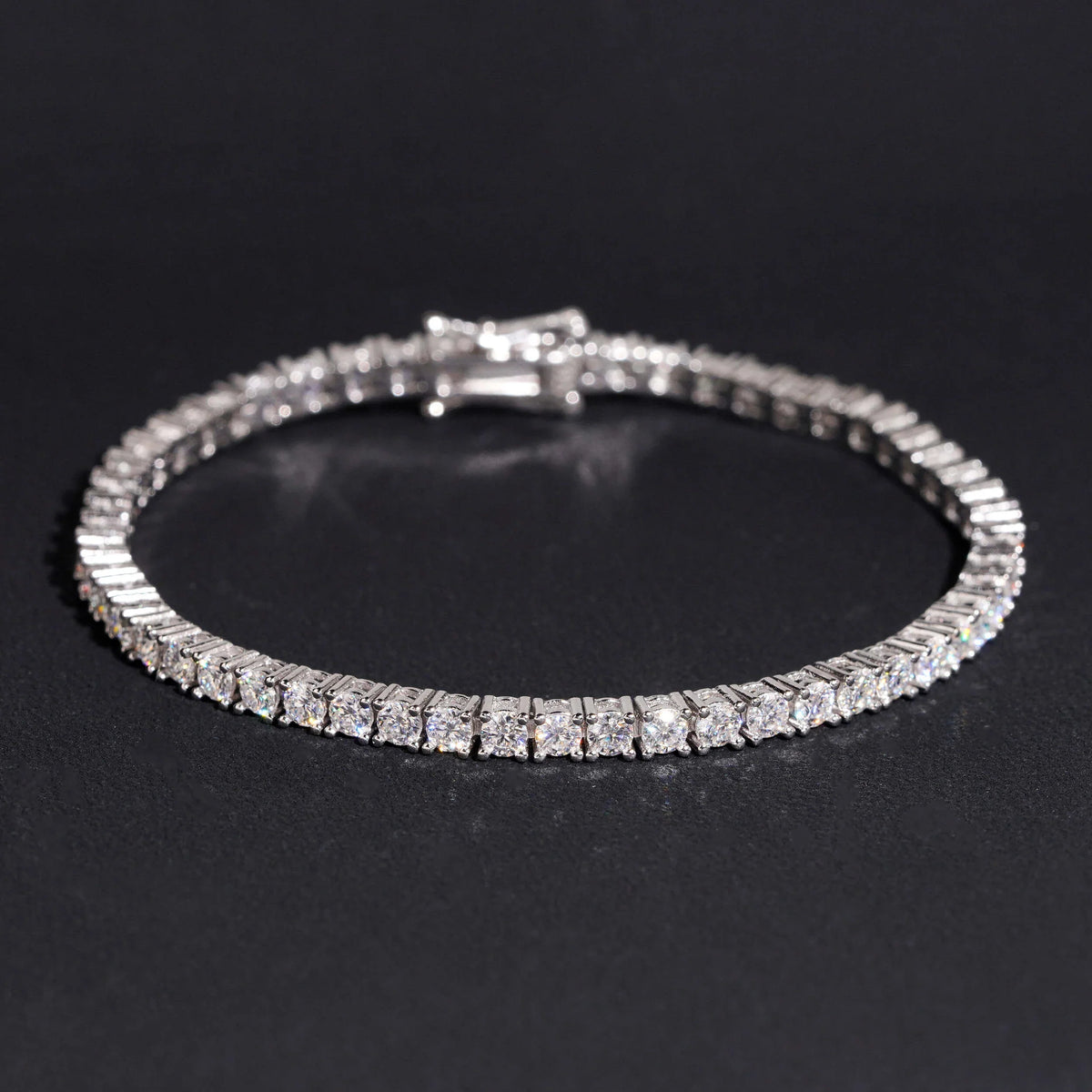
A clean stone should throw light around the way the bracelet above does, little points of color on whatever surface it sits on. When that stops happening, it's usually the film talking.
Keep pavé and iced-out work out of ultrasonic cleaners, since a claw that's already a little loose can come out of the bath worse. Toothpaste, baking soda and jewelry dips are out too — abrasive or harsh enough to strip plating faster than wearing it ever would.
Day to day, a dry microfiber cloth after each wear does more than a deep clean once a month. And if a stone ever sits crooked or shifts when you press it, stop wearing the piece until it's been tightened.
Quick Answers
Can moissanite turn yellow over time?
No. A stone's color is fixed when it's made, and wear does not shift it. When a piece looks warmer than it used to, the usual cause is a film of oil and dust catching the light. Wash it and the original color comes back.
Can moissanite chip or crack?
It can, given a hard knock at the wrong angle, just as a diamond can. Small stones in a pavé chain are shielded by the metal around them, so they're less exposed than a big solitaire. On a ring with a large center stone, the exposed edge is the part to protect.
Is it okay to sleep in a moissanite chain?
Better not. Overnight twisting strains the hinge, and the side pressed into the pillow rubs for hours, so take it off and lay it flat.
How can I tell if the dullness is the stone or the metal?
Look at the metal between the stones. Darker metal, or color that looks patchy, points to the finish. If the metal looks fine but the stones look hazy, it's film, and a wash will sort it out.
Is solid gold worth it for a chain I wear every day?
If you wear it daily, swim in it, or just don't want to think about care, solid gold takes the plating question off the table. You pay considerably more for it, and the stones are the same either way. For a chain that comes out on weekends and for events, plated sterling holds up well with the care above.
Choosing a Piece You'll Wear Every Day
When daily wear is the plan, width and metal matter more than the stones. Wide iced-out Cuban chains carry more stones, which means more places for film to hide. Slim tennis chains have fewer gaps and dry faster after a rinse.

Each stone on a prong-set row like this one sits up on its own claws, so light gets in underneath and a soft brush reaches the back of every seat. The full moissanite chain range runs from wide Cuban links to slim rows like this, and anything from the moissanite pendant collection usually holds its finish better than a ring or bracelet does.
Already own one? The care sections in the tennis chain guide and the Cuban link guide go through storage for each style. Want a chain built in 10K or 14K gold from the start? Our custom team can quote it.
About the author
Written by Iris, who looks after the moissanite side of CustomHipHop's content. For this one she went through the metal specs on the store's live listings in October 2026 and lined the care advice up against what the collection pages already tell buyers, so the two say the same thing.