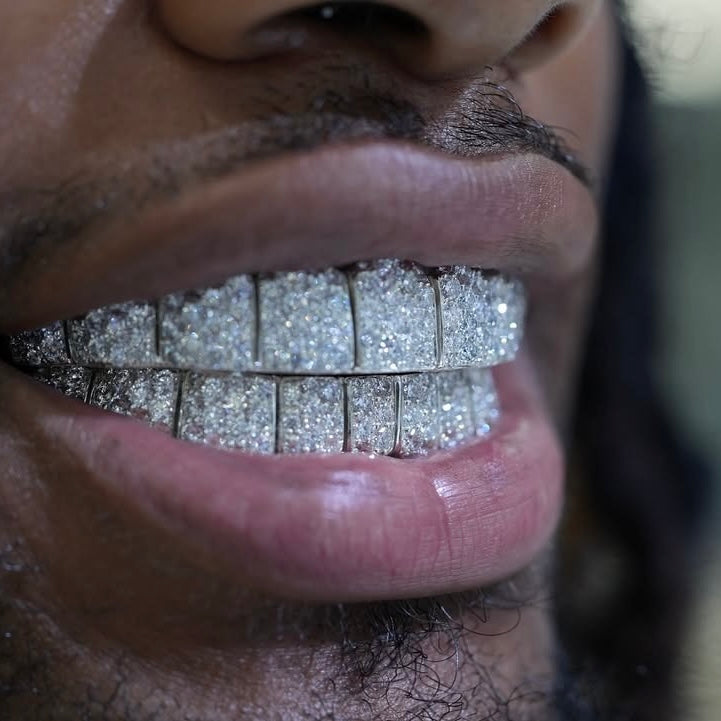


A tennis chain is one row of stones and nothing else. That's exactly why it's so easy to buy the wrong one. Two rows can look identical on a phone screen and sit $2,000 apart in price, because almost everything that matters disappears at photo resolution — how wide the row is, how each stone is held, what the stone actually is, what the metal underneath is doing. This guide walks through the decisions in the order you actually make them: width, length, stone, metal, and what the row should cost. Every size range and price band below is pulled from our own tennis lineup (the tennis chain collection, the moissanite tennis bracelet collection and our lab grown diamond tennis ranges), not from a generic size chart.
1. What Is a Tennis Chain? (And Why It's Called That)
Strip it back and a tennis chain is a single unbroken line of stones, each one held in its own small setting, with those settings linked to each other so the row bends like a ribbon. There's no chunky link, no braid, no filler metal doing the work. The stones are the chain. It's what keeps the style quiet rather than shouty, and it's also why the build quality shows up so fast. There is nothing else to look at, so every crooked stone and every gap in the row sits right there on your neck.
The name comes from a broken clasp. As the story is usually told, Chris Evert's diamond line bracelet snapped during a US Open match (accounts put it in 1978 or 1987, depending on who's telling it) and she asked officials to pause play while she found the stones. Commentators started calling it "that tennis bracelet," jewelers picked the phrase up, and a style that had been sold for decades as a line or eternity bracelet got renamed by accident. When hip-hop took the same construction and ran it up the neck, the name went with it, and that is how a necklace ended up being called a chain.
2. Tennis Chain vs Tennis Bracelet vs Tennis Necklace
These three names describe the same construction in three places, and shoppers mix them up constantly. A tennis bracelet is the wrist version, sized roughly 6" to 9". A tennis chain and a tennis necklace are both the neck version, sized roughly 16" to 28". The difference is vocabulary, not product. People shopping hip-hop jewelry say "chain." People shopping fine jewelry say "necklace." Both land on the same row of stones, so our neck styles live together in the tennis chains and necklaces collection while the wrist styles sit in moissanite tennis bracelets.

The one place the distinction earns its keep is matching. Because a tennis row is defined by stone size rather than link pattern, a 3mm bracelet and a 3mm chain read as a set in a way that two different chain styles never will. If matching is the goal, match the millimeter before you match the metal tone. The eye catches a mismatched stone size long before it catches white gold next to yellow.
Before you shop, two smaller variations are worth knowing. A tennis anklet is the same row again at around 9" to 10", and it's the one length almost nobody stocks, so plan on having one made to order. And a graduated row, sometimes listed as gradient size, runs small at the clasp and biggest at the front. That changes how you size it as well as how it looks; more on that in section 6. Everything else you'll see advertised is a setting or cut variation on that same basic idea. The next section covers those.
3. How a Tennis Row Is Built: Settings, Links and Clasps
Every tennis row is a chain of tiny settings, and the setting style changes both the look and how much light escapes. Four of them cover most of what we make. Four-prong is the classic. Metal claws grip each stone at the corners, leaving the sides open so light passes through. It's the brightest option and the traditional one. Bezel wraps a thin metal rim all the way around each stone, as on this bezel-set 3mm/4mm tennis bracelet; you trade a little sparkle for a smoother row that snags less on sleeves. Cluster (sometimes called halo) rings each center stone with smaller ones, so a 3mm cluster tennis bracelet covers far more surface than a plain 3mm row. Our moissanite chains use the same setting up on the neck. Baguette swaps round stones for rectangles set edge to edge, giving the flat, tiled look on our baguette tennis bracelet. A fifth variation worth knowing is the fancy cut, where no two stones in the row are quite the same shape. The 8mm fancy cut tennis bracelet is the clearest example.

Get close to any row and the setting is the first thing you can actually judge. In the shot above you can count the individual claws holding each stone and see daylight passing between the settings. That gap is the main argument for prongs over a solid rim.
Now turn to the part nobody photographs. The clasp, and the back of the row. A tennis row carries its weight on one hinge, so a box clasp with a folding safety latch is worth more to you than an extra millimeter of stone. Turn any row over before you commit, and check the full length of it. The undersides of the settings should be finished and open enough to let light in from behind. Closed, rough backs are where cheap manufacturing hides. Then hold the row up by one end. It should hang in a smooth curve; if it kinks or twists, the links are inconsistent, and a row that kinks in the box will kink on your neck.
“Solid piece, great for layering. A little adjustment on clasp needed but overall great.” — Devon C., verified buyer
4. Width Guide: 2mm to 13mm
Nothing else you choose moves as much as this one does: presence, price, and whether the piece works on a Tuesday or only on a stage. Our tennis rows run from a whisper-thin 2mm up to a 13mm statement row. Read the table with one thing in mind. Each range below spans the moissanite pieces we offer at that width, bracelets and chains, gold-finished sterling and solid gold together, which is where the wider bands come from. The low end of every range is a sterling-based piece. The top end is a solid-gold build of the same millimeter at some widths and a heavier sterling one at others. We only make solid gold at a few widths, so 4mm and 8mm run far wider than 2mm and 3mm do. Section 9 explains what that gap buys you. Every figure here is moissanite only (lab-grown diamond rows are priced separately in section 8), and all of it was checked against live product pages on August 1, 2026.
| Width | How it reads | Best for | Moissanite range at this width (sterling-based low end → solid gold high end) |
|---|---|---|---|
| 2mm | Barely there, a line of light | Layering under a heavier chain, first piece, anyone who hates fuss | $54 – $235 |
| 3mm | Clean and legible from arm's length | Daily wear, matching chain-and-bracelet sets | $55 – $595 |
| 4mm | Noticeable without announcing itself | The safest single choice if you're buying blind | $58 – $3,880 |
| 5mm | Reads as jewelry across a room | Wearing solo, photos, evenings out | $90 – $1,250 |
| 6mm – 6.5mm | Heavy row, still comfortable | Stepping up from 4mm without going full statement | $155 – $1,970 · 6mm in 10K solid white gold |
| 7mm – 8mm | Big-stone territory, each stone visible | One-piece flex, wearing over a plain tee | $160 – $9,900 · 8mm 2ct-per-stone row in 10K solid gold |
| 10mm – 13mm | Statement row, stage-scale | Photos, performance, collectors | $160 – $1,650 · 10mm baguette-lock chain in 925 silver |

The ranges are not uniformly wide, and where they blow open tells you something. On four of them (4mm, 5mm, 6mm–6.5mm and 7mm–8mm) you are looking at two products sharing one line, a sterling piece at the bottom of the band and a solid 10K gold version of it at the top. That one fact is why 4mm starts at $58 and finishes at $3,880. The other three rows stay sterling all the way up, so the $1,650 at the end of the 10mm–13mm band is a heavy 925 statement chain with no solid gold in it. The band tells you more than the millimeter does. If you are choosing without seeing the piece in person, 3mm to 4mm is the safest landing zone, for an unglamorous reason. It is wide enough to be seen and narrow enough to disappear under a collar when you need it to.
5. A Closer Look at the Three Core Widths
Three widths carry most of the range, and each one fails differently if you pick wrong. 3mm is the one to start from. It sits high and tight enough to work as a choker-length row, it layers under anything, and it's the width where a matching set makes the most sense. The 925 silver 3mm tennis bracelet with GRA certificate is the reference version of it, and it carries a GRA report at a price most people expect to pay for plated costume jewelry.
Step up to 4mm when you want the row noticed without it being the only thing anyone notices. It's the point where you stop seeing one continuous line of light and start seeing individual stones, and it is the width we offer on more styles than any other. The 4mm moissanite tennis bracelet keeps that in silver, while the gold-plated moissanite tennis necklace in 2mm–6.5mm lets you take the same stone size up to the neck.
5mm is the last width most people can still forget they have on. Go wider and the row starts making decisions about your outfit; at 5mm it stays out of them. A 5mm heart-and-arrow cut moissanite tennis chain gives a bolder row up top, and the 5mm heart cut tennis bracelet matches it on the wrist. Past that, the 6.5mm VVS tennis chain in white gold and the 8mm–10mm big stone tennis necklace move you into territory where each individual stone carries the look.

6. Length and Sizing Guide
Getting length wrong is the most common regret in this category, and it is the easiest thing to fix before you order. A tennis row has almost no give. Unlike a rope or a box chain, you can't fudge the fit, so measure first.
For a bracelet: run a strip of paper or a tape measure around your wrist just below the wrist bone, snug but not tight, then add about half an inch for a comfortable drape. Add closer to a full inch if you want the row to slide when you move your hand.
For a chain: measure around the base of your neck for a collar-hugging fit, then decide where you want the row to land. Every extra two inches drops the row roughly one to two finger-widths lower on your chest.
| Piece | Size | Where it sits |
|---|---|---|
| Bracelet | 6" – 6.5" | Slim wrists; sits close with little movement |
| Bracelet | 7" | The size we stock on more tennis styles than any other |
| Bracelet | 7.5" – 8" | Average to larger male wrist; the row moves as you do |
| Bracelet | 8.5" – 9" | Larger wrists, or a deliberately loose drape |
| Chain | 16" | Choker length; sits at the base of the throat |
| Chain | 18" | Just below the collarbone; visible with an open collar |
| Chain | 20" – 22" | The lengths we stock most widely; lands mid-chest over a tee |
| Chain | 24" | Sits below the chest; the usual choice for layering under a pendant |
| Chain | 26" – 28" | Long drop; reads as a statement piece on its own |

Fit shifts with width as well. A 6.5mm row eats more of your wrist circumference than a 3mm one, so on anything wide, take the larger of two sizes when you're caught between them. And buyers do tell us when the fit lands. A July 2026 review of our 3mm bracelet from Jessica I. reads "fit my wrist very well, all stones are moissanite diamond with gra report." Those are the buyer's words, not ours: moissanite isn't diamond, and we say so in section 8. The GRA report in that review is real. If a size you need is not listed on a style you want, our custom jewelry team can usually build it.
One style deserves its own note. A graduated row steps the stones up in size toward the center instead of keeping them uniform. The gradient size tennis necklace and bracelet sits differently from a uniform row at the same nominal width, because all the extra width bunches at the front and never spreads out along the length. If you're ordering one, size it the way you would a piece one millimeter wider than its smallest stones.
“The sizing was accurate, 7.5" fits my wrist perfectly.” — Chloe T., verified buyer
7. What "30, 40 and 50 Pointer" Actually Mean
If you have shopped tennis chains for more than five minutes you have seen "40 pointer" or "50 pointer" in a product title with no explanation attached. It's simpler than it sounds. A point is one one-hundredth of a carat. So a 50 pointer is half a carat per stone, not for the whole piece. That's where people get burned — a "50 pointer tennis chain" at a suspiciously low price is usually quoting total carat weight, not per-stone weight, and those two numbers can differ by a factor of thirty.
| Term | Carat per stone | Roughly this stone size | What it costs in our lineup |
|---|---|---|---|
| 30 pointer | 0.30 ct | About 4mm across | VVS lab diamond bracelet, 4mm 30 pointer — $1,832 to $2,443 |
| 40 pointer | 0.40 ct | About 4.8mm across | 10K solid gold 40 pointer lab diamond tennis chain — $7,990 to $11,990 |
| 50 pointer | 0.50 ct | About 5.2mm across | 10K solid gold 5mm 50 pointer lab grown diamond tennis chain — $8,688 to $13,030 |
That table says two things at once. The first is that pointer language belongs to diamonds. Every pointer tennis piece we stock is a lab-grown diamond row, because that is the trade vocabulary buyers use when they are shopping by stone weight instead of by row width. The second is scale. A 50 pointer lab diamond chain and a 5mm moissanite chain occupy roughly the same space on your neck and sit thousands of dollars apart. Which one is right depends entirely on the next section.
8. Moissanite vs Lab-Grown Diamond vs Mined Diamond
Here's the honest version, without the sales pitch in either direction.
Lab-grown diamonds are diamonds. Same carbon crystal, same chemistry, same hardness as anything pulled out of the ground, just grown in a reactor instead of mined, and graded on the same 4Cs scale. Moissanite is not a diamond and is not pretending to be one. It is silicon carbide, its own gemstone, with its own properties. It's slightly softer than diamond but still hard enough for daily wear, and noticeably more dispersive, which is why a moissanite row throws more colored flash than a diamond row of the same size. Some people love that rainbow fire; some prefer the whiter, more restrained return of a diamond. Neither is a fake, and neither is a compromise. They're different stones that suit different budgets and different tastes. Worth knowing that all three read as diamond on a basic thermal pen, which catches people out — how a diamond tester reads moissanite explains why.
| Moissanite | Lab-grown diamond | Mined diamond | |
|---|---|---|---|
| What it is | Silicon carbide, its own gemstone | Diamond, grown in a lab | Diamond, mined |
| Hardness (Mohs) | 9.25 | 10 | 10 |
| Fire (dispersion) | 0.104 — more colored flash | 0.044 | 0.044 |
| Certificate you'll see | GRA report | IGI or equivalent lab report | GIA or equivalent lab report |
| 3mm row here | $55 – $595 median $195 |
$720 – $5,295 median $1,790 |
Not stocked |
| 4mm row here | $58 – $3,880 median $236 |
$1,310 – $4,350 median $3,410 |
Not stocked |
| 5mm row here | $90 – $1,250 median $321 |
$1,150 – $13,030 median $8,688 |
Not stocked |
Ranges and medians are taken across the pieces we offer at each width, so individual products land either side of them. The 4mm 30 pointer lab diamond bracelet in section 7 starts at $1,832, under the 4mm median. The 5mm lab diamond median sits high because most of what we carry at that width is solid gold; the range on that row is the more useful number.
Read the bottom three rows again, because the decision comes down to those three numbers. At the same width, on the same wrist or neck, our moissanite rows and our lab-grown diamond rows sit roughly nine to fifteen times apart on median price at 3mm and 4mm, and further apart still at 5mm, where the gap widens mostly because our 5mm diamond stock happens to be solid gold, so you're paying for two upgrades in one. If the piece is going on daily and you want the row to be wide, moissanite is what makes that affordable. If you want the stone itself to hold value as a diamond, the lab grown diamond tennis bracelet range and the diamond tennis necklace range are where to look, and the wider lab grown diamond jewelry selection covers the same stone in other styles. We stock both, and we're not going to tell you the cheaper one is secretly the same thing. Anyone who does is either confused or counting on you being confused. (Fuller breakdown: moissanite vs diamond.)
9. 925 Silver, 10K and 14K: What You're Paying For
Two chains can both say "14K gold" on the tag and be built nothing alike. One has gold running through it. The other has gold sitting on top of silver. The listing does not always tell you which one you are holding, so here is how to read past it. Most iced-out tennis rows, ours included, are built on a 925 sterling silver core carrying a gold finish, which is where the white, yellow and rose options come from. That's not a shortcut. A tennis row asks more of its base metal than a solid chain does, because every setting has to stay clamped on a stone while the whole row flexes. Sterling has the density to do that; thin base metals bend and let stones go. The gold layer decides color and how the finish ages, not whether the settings hold.
Where it matters is thickness and honesty of labeling. A bonded or heavy gold finish over sterling behaves very differently from flash plating measured in microns, and only one of them survives a year of daily wear. 10K and 14K solid gold pieces, like the pointer chains in section 7, are a different product entirely. There the karat number describes the metal all the way through, not a layer sitting on top of it, and you pay accordingly.
Do two things before you buy anything in this category. First, look for the stamp. A genuine sterling piece is marked 925, usually on the clasp or a tag near it. A buyer named Xionell T. led with it in a review, before saying anything about the look: "super clean marked s925 and passed the diamond tester." Second, make sure the listing tells you which it is. If a page says "14K" without saying whether that means solid or a finish over another metal, that omission is your answer. On our listings the base and the finish are stated separately on the product page.
10. How to Spot a Low-Quality Tennis Row
Because a tennis row has nowhere to hide, five checks catch almost every bad one.
Look at the row edge-on. The stone tops should form a straight line. If some sit higher than others, the settings were not seated properly and the high ones will catch and loosen first.
Check the backs. Every setting should be finished behind the stone. Rough, unopened backs both dull the stone and tell you where the manufacturer stopped caring.
Work the clasp ten times. It should close with a definite click and hold when you tug. A safety latch is not decoration on a piece whose entire value hangs from one hinge.
Ask what the certificate covers. A GRA report on moissanite is normal and worth having; a lab diamond should come with an IGI-style report. Watch for the classic swap, where a page waves a certificate belonging to a different stone type than the one you're buying.
Weigh it in your hand. A sterling-based row has real mass. If a wide row feels like plastic, the settings are hollow and the piece will bend out of shape.

One more, and it is specific to stone-set jewelry. Buy from somewhere that will tell you what you're getting when you ask. On our side that means a GRA report travels with the moissanite, and the great majority of our tennis rows state VVS clarity on the listing itself. The metal and the stone are both spelled out on the product page, so you never have to infer them from a photo.
“Shipping was fast and the bracelet came with a GRA certificate.” — Ashley W., verified buyer
11. Tennis Chain and Bracelet Pricing Explained
Our own tennis rows run from $54 to $13,030. Nobody prices a chain at thirteen thousand dollars on a whim, and nobody sells a real one for fifty-four by accident either. Four variables are doing that arithmetic. Learn to name them and no price on this page looks random again. In rough order of how hard they push:
- The stone. As section 8 showed, this dwarfs everything else. A lab-grown diamond row runs many times the price of a moissanite row at the same width.
- The metal. Solid 10K or 14K gold multiplies the cost of the same design several times over a gold-finished sterling build.
- The width and length. Both are just "more stones," and the stones are the product, so a 24" chain costs more than an 18" of the same style for the same reason a 5mm costs more than a 3mm.
- The setting. Cluster and baguette work take more hours per inch than a plain four-prong row, and you can feel it before you can price it. More metal edges under the thumb, more joins, more places somebody had to sit and set a stone by hand. Compare the emerald and round cut mixed tennis chain or the 5mm spike tennis chain against a standard row and you can see where the labor went.
In practice, our moissanite tennis rows sit in the low hundreds for most widths. A 2mm moissanite tennis chain in gold-plated 925 silver starts at $60, a 3mm–4mm ice blue moissanite tennis chain from $95, a pear cut VVS tennis bracelet from $310. They top out in four figures on wide statement rows like the 13mm VVS moissanite tennis chain, which runs $980 to $1,500 depending on length. Diamond rows start where those end. If a price seems impossible for the width and stone claimed, one of those two claims is doing something dishonest.
12. How to Care for a Tennis Row
Tennis rows are low-maintenance, with one exception. They carry more settings than any other chain style, so they collect more of what your skin and your day leave behind. Warm water with a little mild dish soap does the job. Work gently along the row with a soft toothbrush, from behind as well as the front, since that's where film builds and kills the return. Then rinse and dry flat on a towel. Skip ultrasonic cleaners and anything with ammonia or bleach. On a solid chain that advice is precautionary; on a tennis row it's specific. An ultrasonic bath vibrates hundreds of individual settings at once, and a prong that was merely loose comes back open.
Take it off before the gym, the pool and the shower. Chlorine and salt are hard on gold finishes, and sweat gets into settings you can't easily reach. Store it laid flat or hung, never coiled in a drawer with other chains. A tennis row tangled around a Cuban link is how prongs get bent. Once or twice a year, run a fingernail slowly down the underside of the row. Feel a stone shift, or hear a faint tick, and get it tightened before it turns into a gap.
“Lightweight but feels solid, great for everyday wear.” — Rachel W., verified buyer
13. One Row or Layered? How to Stack
A tennis row wears well alone. That's the whole point of the style. But it also layers better than almost anything else, because a single thin line adds sparkle without adding visual bulk.
On the neck, the rule that works is contrast in texture, not in width. Put your narrowest row, a 2mm or a 3mm at most, against something structurally different, like a Cuban link, a rope or a pendant chain. Let the tennis row sit shortest, closest to the collar, where its continuous line stays legible against the pattern below it. Two tennis chains of similar width layered together mostly just look like one thicker chain that didn't quite line up. If you want the second layer to carry a pendant, hang it from the longer chain and keep the tennis row bare. Anything from our moissanite pendants works, and a longer style like the cross tennis rosary chain necklace already builds the pendant into the row.

On the wrist you can be greedier. Two or three slim rows stack cleanly, and mixing metal tones across them looks intentional. If you already wear a watch, run the stack on the other arm or keep it to one 3mm row on the watch side. A wide row next to a case fights for the same space and scratches it. There is a ceiling, though. Five slim rows tip from a stack into a costume, and no amount of browsing our moissanite bracelets changes that.
“A timeless bracelet, perfect for stacking or wearing solo.” — Joseph J., verified buyer
14. Tennis vs Cuban: Which Iced Chain Suits You?
These are the two chains people cross-shop, and they are opposites in almost every respect that matters.
A Cuban link puts metal first. Interlocking flat links carry the stones as decoration, on a structure that would still be a chain without a single one of them. It's heavier, broader, and reads bold from across a room. Take the stones off a tennis row and you're holding nothing at all. It sits lighter and closer to the skin, and at the widths most people buy it whispers where a Cuban shouts. Go past 8mm and a tennis row will carry a room too, but that is the exception here. Cuban is a statement you make on arrival. Tennis is one people notice at conversational distance, closer and quieter and usually more expensive than they guess.
Practically speaking, pick Cuban if you want one heavy piece that carries an outfit, if you like a chain with visible mass, or if you want a pendant hung from something substantial. Pick tennis if you want the piece to work under a collar, if you plan to layer, or if you want the wrist and neck to match. Plenty of people own both and wear them together. A slim tennis row over a wide Cuban is one of the most reliable pairings in the category. If Cuban is where you're leaning, our Miami Cuban link chain buyer's guide covers width, gold and pricing the same way this one does, and the Cuban link chain collection shows the full range. To see how both sit alongside other styles, the moissanite chains hub is the wider view.
15. Frequently Asked Questions
What does "40 pointer" mean on a tennis chain?
A point is one hundredth of a carat, so 40 pointer means each stone in the row weighs 0.40 carat, roughly 4.8mm across. It describes per-stone weight, not the total carat weight of the piece, and confusing the two is how an impossible-looking price gets quoted. See section 7 for the 30, 40 and 50 pointer comparison.
Why do two tennis chains of the same width cost so differently?
Width tells you almost nothing about price on its own. It's the stone and the metal underneath doing the work, and neither one shows up in a product photo. Our own 4mm band runs from $58 to $3,880 for exactly that reason. A plated sterling row and a solid 10K gold row can both measure 4mm. Section 11 breaks the four factors down in order of impact.
Why does moissanite flash more color than diamond?
Dispersion: how much a stone splits white light into spectral colors. Moissanite measures 0.104 against diamond's 0.044, so the same row throws noticeably more rainbow flash. It's a different stone, not a lesser one. Silicon carbide instead of carbon, 9.25 on the Mohs scale, supplied here with a GRA report.
How do I measure my wrist for a tennis bracelet?
Measure the bare wrist just under the wrist bone, snug against the skin, and write that number down. Your size is that measurement plus roughly half an inch, or nearer a full inch if you like the row loose enough to travel up and down your hand. Anything 6mm or wider eats into that allowance, so take the larger size when you are caught between two.
How long should a tennis chain be?
16" sits at the throat, 18" lands just below the collarbone, 20" to 22" falls mid-chest over a t-shirt, and 24" and beyond sits low enough to layer a pendant chain beneath it. Add length in two-inch steps and watch where each one lands on your chest.
Can a tennis chain be shortened?
Yes, though it costs more than shortening a plain chain. On a tennis row the jeweler is taking out whole stone settings and rebuilding the join to the clasp, and the row still has to come out symmetrical afterwards. Losing more than an inch or two that way rarely ends up cheaper than ordering the size you want. Section 6 has the measurements; if the length you need isn't on the listing, our custom jewelry team can make it to your measurement.
What's the difference between gold-plated and solid gold on a tennis chain?
On a tennis row it matters more than on most chains, because the gold is part of what holds the settings under tension. A finished piece is sterling with gold bonded over it; a solid 10K or 14K piece is that gold all the way through. Both are legitimate. What to avoid is a listing that says "14K" without saying which one it means. Section 9 covers how to read the labeling.
Find Your Tennis Chain
Start with width, then length, then stone, in that order. Browse the full tennis chain and necklace range, the moissanite tennis bracelet range, or begin a custom build. A few places to start:
Shop →
Shop →
Shop →
Shop →
Shop →
Shop →
About the author
Iris covers moissanite hip-hop jewelry for CustomHipHop. She works hands-on with the store's tennis chains and bracelets and the questions buyers ask before they order, and checks every size, spec and price in this guide against what the store actually stocks and stands behind.