

A six-tooth row of moissanite grillz starts around $420 at our bench. A fully iced ten-across on both arches runs into the thousands. Four things move that number: the metal, how many teeth you cover, how much of each tooth face is covered, and whether the piece is molded to your own bite. Plan on about four weeks once we have your bite on file.

1. What Actually Drives the Price of Grillz
Ask five shops what grillz cost and you'll get five different answers, because nobody's pricing the same thing. One is quoting a set that ships tomorrow. Another is quoting a build cast from your own impression. Those are not the same product and they shouldn't carry the same number.
Four things move your number, roughly in this order of impact.
The metal. A solid gold build and a gold-plated sterling one can look identical in a photo and still sit thousands of dollars apart. Widest fork in the road by a distance.
Your coverage. Six teeth, eight or ten, one arch or both. Stones go in by hand, so coverage is really a measure of bench time.
The surface. A plain row of round stones and an invisible-set front take very different hours to build, even at the same coverage.
Whether it is molded to you. This one hides underneath the other three, and it is why nothing custom starts at $50.
Get those four straight and no quote you're handed, ours included, looks random again.
2. Gold-Plated vs Solid Gold: Where Most of the Gap Comes From
This is the number people miss, and it's the reason two quotes for "10K gold grillz" can sit thousands of dollars apart.
Everything we build is 925 sterling silver finished in 10K or 14K gold plating. We do not cast solid gold. That is worth stating plainly up front, because most of the prices you will find quoted elsewhere are for solid gold — and comparing a plated price to a solid one is not a comparison at all.
Here's how the market sorts out, using figures taken from four US custom grill retailers' own published price guides, checked in August 2026:
| Type | What others list | What we build |
|---|---|---|
| Ready-made, off the shelf | $10 to $50 a set | Not something we make |
| Custom-molded, moissanite | $120 to $150 per tooth | From about $70 per tooth |
| Custom-molded, plain solid gold | $150 to $250 per tooth ($2,400 to $4,000 for eight across) |
Not something we make |
| Custom-molded, mined diamond | $1,000 to $5,000 per tooth | Not something we make |
Per tooth is how the trade quotes it, but you are buying a row, not a tooth. Eight across at our entry rate lands near $560. That same row at the going market rate for custom moissanite would run you $960 to $1,200.
Two things jump out of that table. The first is that our entry sets land at roughly half the going rate for custom-molded moissanite work. The second is that there is no honest way to put a $30 pre-made set in the same row as anything molded, which is why the top line says what it says.
Gold plating is not a shortcut so much as a different set of trade-offs. You get the tone and the weight of a sterling base for a fraction of a solid build, and the plating is the part that needs care; the sterling underneath looks after itself. If you want the long version of that trade-off, our tennis chain and bracelet guide breaks down plated and solid side by side.
Plating comes in white, rose and yellow. Rose is the tone people come looking for most often, which surprises anyone who has been picturing a set and quietly assuming yellow is the default.
All prices on this page are current as of August 2026 and move with the gold market.
3. Price by Teeth Count: 6, 8 and 10 Across
Here's the part most price guides skip. Grillz are priced per tooth, not per set, and once you know that the whole menu makes sense.
Right now everything we build comes in one of three coverages. Six across is the front six only, which is roughly what shows in normal conversation. Eight across reaches the width of a full smile. Ten across keeps going past the canines, into the zone you only see when someone really laughs.
You'll also see these written as 6-on-6, 8-on-8 and 10-on-10. Same thing, counted per arch, and it's the shorthand most shops use on the product itself.
Any of the three works as a single arch, top or bottom, or as a matched pair. A single arch is exactly what it sounds like, and it's the honest answer to "how do I do this on a budget." On our entry sets a top row of six lands at $420, eight at $560, ten at $700. Take both arches and you're doubling that, so ten-on-ten comes to $1,400.

A bottom row costs the same as a top row of the same count, so the choice between them is about how you want to be seen — not about the money. Bottoms show less when you speak, so people who want the piece without the announcement usually start there.
Move up through the range and the per-tooth figure climbs because of the metal and the setting work. Coverage is not what moves it. The heaviest builds we take on are fully custom, and a ten-on-ten in 10K rose gold plating sits around $7,000 at the moment. Same three coverages, very different bench hours.
Run it backwards if a budget is where you're starting rather than a design. About $420 puts a six-across top row on the table. Around $840 either brings the second arch in at that same coverage, or keeps you on one arch and buys a heavier build instead. Past $2,000 the question stops being how many teeth: that is the point where the setting work costs more than the extra teeth do, and a ten-across entry set and a six-across in a demanding setting can land within a few hundred dollars of each other.
Single teeth and two-tooth pieces are the one thing we don't make. Six across is where the range starts, and that line is deliberate. Anything narrower and the mold work costs nearly as much as the piece.
Browse the full range in moissanite grillz to see how the coverages and metal tones line up.
4. What the Stone Work Adds
Two sets with the same coverage and the same plating can still price differently, and it comes down to what is happening on the surface.
A round-stone row is the baseline. Uniform stones, four prongs each, set in a line. Fastest on the bench, least labor-intensive of the three, and the look most people picture when they picture grillz. Our ten-across in 14K white gold plating is that build at full coverage.
Baguette bars swap the round stones for rectangular cuts laid end to end. Every bar has to line up with the one beside it — and a crooked join shows from across a table, as you can see on our baguette set in rose gold plating. You can feel the difference under your thumb before you can price it.
An invisible setting moves the metal that would normally sit between stones underneath them instead, so the surface reads as one continuous sheet of light with no prong shadows breaking it up. Square stones sit shoulder to shoulder, and any gap or tilt shows immediately because there is no metal outline to hide behind. Nothing else on this list takes as long to build.
It's also, going by what actually brings people to this page, the thing they're most curious about after the price itself. If you've seen a set that looked like one solid block of light rather than a row of individual stones, this is what you were looking at.

Lettering is its own thing. A custom letter front means cutting and setting shapes that do not repeat, so the bench time doesn't scale the way a uniform row does. Our custom letter set shows what that looks like finished.

You can see the three sitting side by side in our moissanite grillz lineup, which is the fastest way to work out which surface you actually want.
One thing to be clear about, because the category is full of loose language: every stone we set in a grill is moissanite, not diamond. Moissanite is a lab-created gemstone with its own crystal structure, and most of what we use is VVS grade with a GRA report in the box. It is not a diamond, and we do not sell it as one.
5. Why Moissanite Grillz Cost Less Than Diamond
Run the two side by side and the gap is not subtle.
Custom-molded diamond grillz are quoted at $1,000 to $5,000 per tooth by shops that publish their numbers. Our entry moissanite sets work out to about $70 per tooth. That is not a discount on the same thing. It is a different stone, and the whole argument for grillz specifically is that the stone barely has to defend itself here.
Think about where a grill actually lives. It sits in your mouth, comes out for meals, gets handled every day and spends the rest of its life in a case. It's seen at conversational distance, under phone flash, in photos. Put a stone in that setting and moissanite stops being a concession and starts being the better pick: its dispersion runs more than twice a diamond's, so it breaks light into color where a diamond returns it white. Under a phone flash at talking distance, that difference is the entire effect people are buying.
Hardness holds up too. Moissanite sits at 9.25 on the Mohs scale, behind diamond at 10 but ahead of sapphire and ruby, so the daily in-and-out does not dull it.
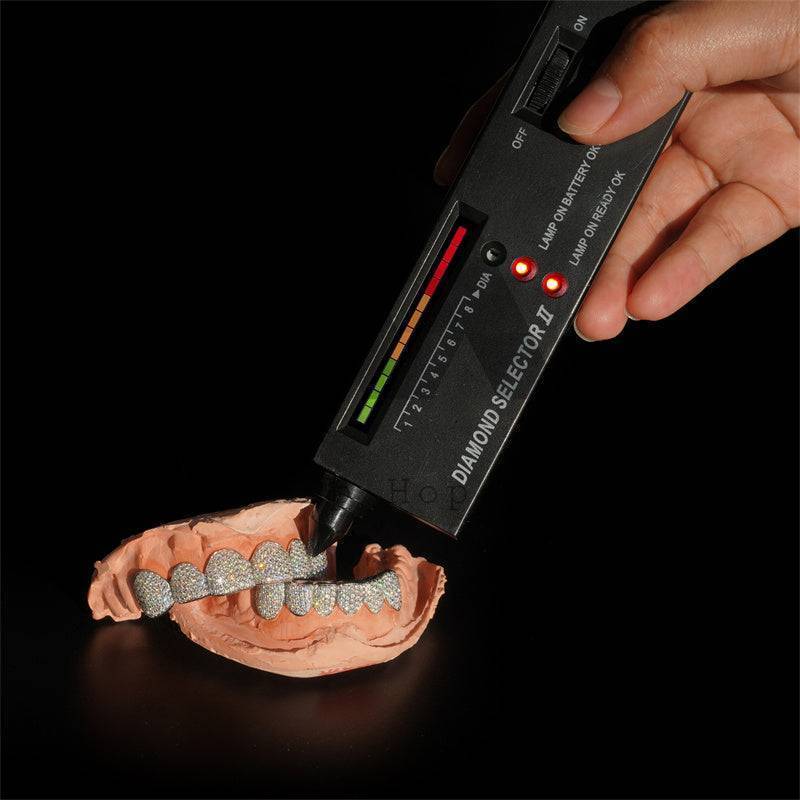
One quirk catches almost everyone off guard, and it comes up more often than you'd expect. Hold a standard thermal diamond tester against a moissanite stone and the needle swings to diamond — the two move heat at almost the same speed. We took that apart properly in a separate guide to why moissanite reads as diamond on a tester.

Which tells you something practical: at talking distance, under a phone light, across a table, nobody is running a loupe over your teeth. The stone does exactly what you want it to do in the situations you'll actually be in.
What we won't do is let that stand in for a claim. A tester that also reads electrical conductivity separates the two in a second, a jeweler spots it through a loupe, and every listing we publish names the stone. So does the GRA report in the box.
Where a diamond earns its price is resale and paperwork, and neither of those is why anyone buys a grill. If you want the full head-to-head on fire, hardness, testing and certification, we wrote it up in our moissanite vs diamond guide.
6. Custom-Molded vs Ready-Made: What the Process Costs
The $30 sets are real. They exist, they ship fast, and they answer a different question than this page does.
Here is the part that explains the whole price floor: on a molded set, most of the cost lands before anyone picks up a stone.
A ready-made grill is stamped to a generic arch. The tooling was paid for once, thousands of units ago, and every set that comes off it is identical. Spread across a production run, the setup cost per set rounds to nothing. Real manufacturing advantage, and it's why the number can be $30.

A molded set restarts that clock for one person. Your bite has to be captured, checked and turned into a working base that matches your arch — and none of that work carries over to anybody else's mouth. Call it a setup cost of one. That figure does not shrink as you add teeth, so our range opens at six across instead of one or two. On a two-tooth piece the groundwork would cost close to what the piece itself costs, and quoting that honestly would look absurd.
You feel that difference every time you wear it, not just when it goes in. A set cast to your own arch grips the teeth rather than resting on them, so it tends to stay put while you talk instead of shifting around. The generic ones slide, and most people notice inside the first hour.
Getting your bite on file is where this actually starts, and there are two ways in. Most people book a short appointment at a local dental clinic and have the arch scanned. The scan comes to us as a digital file, so nothing sits in the post and nothing can shift on the way. The older route still works too: take a physical impression and mail it over. Both get us to the same place, but a file does not warp in a padded envelope, and that difference is the reason we point people at the scan first. If getting to a clinic is awkward where you are, say so and we'll send the kit instead.
After the base, the arithmetic turns linear again. Stones go in by hand, so the remaining cost scales with how many of them there are and how fussy the setting is. That's the part section 3 and section 4 price out.
There's a timing cost too, and it lands on you more than on the invoice. Figure on roughly four weeks at the bench once we have your bite on file. If you scanned, that clock starts almost as soon as you leave the chair. If you posted an impression, add whatever the mail takes at both ends, which is usually the longest and least predictable part of the whole thing.
So a $50 grill is not a cheaper version of what we do. It skipped the step our price is mostly made of.
One consequence worth saying out loud: a set molded to your arch fits one mouth, so a custom build is not returnable. Fair trade for something shaped to you, and it is why the design, the coverage and the quote all get settled before anything is cast. It is also why nothing ships until you've seen photographs of the finished piece. Anything that needs adjusting happens at the bench, not in your mouth.
Everything quoted on this page covers our standard builds. Lettering, unusual shapes, heavier stone coverage and the shape of your own arch all move the number, so if you have something specific in mind, walk us through it on our custom design page or open a chat and we'll price it out. Nothing gets committed by asking.
7. Frequently Asked Questions
Is a top row on its own cheaper than a full set?
Yes, and by exactly half. A single arch is priced on its own, so a top row of ten on our entry sets is $700 where ten-on-ten across both arches is $1,400. A bottom row costs the same as a top row of the same count. Starting with one arch is the usual way in if the full set is a stretch.
Are grillz under $100 the same thing?
They're a different product wearing the same name. Sets in that range are pre-made to a generic arch, so they rest on the teeth without ever gripping them. Nothing about them is dishonest — they are just solving a different problem. Anything built to your own arch starts higher, because that groundwork happens before a single stone gets set. See section 6.
How much should I budget for a first set?
Around $420 gets you a molded six-across top row in gold-plated 925 sterling silver with VVS moissanite. That is the usual starting point. Same build as the rest of the entry tier, just across fewer teeth. Most people who come back for more coverage later do it by adding the bottom arch to what they already own.
Why are grillz priced per tooth instead of per set?
Because the bench time builds up stone by stone. Each one is placed and secured by hand, so what a row costs tracks how many stones are sitting in it. Quoting per tooth is simply the honest unit for that kind of work, and it's also why a single arch lands at half a double instead of some arbitrary fraction.
Find Your Set
Coverage first, then metal, then the surface. That order tends to save people the most money, because the first decision moves the number furthest and the last one is the easiest to change your mind about later.
Starting at the bottom of the range? The entry tier lives here — single arches, round-stone rows, the plainest plating we do. Adding the second arch doubles it. Adding teeth walks it up in steps rather than jumps.
Above that the ordering gets less obvious, because price stops tracking coverage and starts tracking the surface. Easiest way to see it for yourself is to run the whole range from lowest price up and watch where the jumps land.
Lettering, unusual shapes, a bite that needs a bit of work — those go through the custom build page. Tell us the coverage, the cut and the metal tone you have in mind and you will get a real number back. Reference photos help more than descriptions do.
About the author
Iris covers moissanite hip-hop jewelry for CustomHipHop. She works hands-on with the store's custom grillz and the questions buyers ask before they order, and checks every price and spec in this guide against what the store actually stocks and stands behind. Every figure on this page was pulled from the live listings in August 2026, and our own prices were checked again in September. They still hold.