

Yes, on the black pen with the metal tip that most people mean when they say diamond tester. Touch it to a moissanite stud and the lamp climbs into the diamond band, same as it would on a mined stone. That's not a fault in the tool and it isn't a trick in the stone. The pen is doing precisely the job it was built to do, and that job turns out to be far narrower than almost anyone assumes.

1. What a Diamond Tester Actually Measures
The black pen with the metal tip is a thermal probe. It warms the tip, presses it to the stone, and times how quickly the heat drains away. Nothing more. It doesn't read chemistry, it doesn't look at the crystal, and it has no idea what it's touching.
That matters because of how far apart the candidates sit. Diamond pulls heat off the tip faster than almost anything else you can set in jewelry. It drains the probe before the probe has finished asking. Glass, plastic and cubic zirconia sit there and warm up. The gap between those two is enormous, so a cheap diamond tester can sort them with a single threshold and get it right nearly every time.
So here's the honest version of what the pen tells you: it answers "is this glass or CZ?", not "is this a diamond?" Everyone reads it as the second question. It has only ever answered the first.
2. Why Moissanite Clears the Same Threshold
Long before anyone set it in a chain, silicon carbide was doing industrial work: grinding wheels, brake discs, the power electronics inside an electric car. It got those jobs partly because it dumps heat so well. Moissanite is that same material, cut and polished. Its thermal conductivity lands nowhere near glass or CZ. It lands in the neighborhood the pen was told to call diamond.
So moissanite clears the threshold on the first touch. Not marginally, either. It isn't squeaking past a test it barely fails; it belongs to the same broad group the test was designed to isolate.
This caught the trade off guard once. Thermal probes had been the quick answer for years, and then a gemstone turned up that read the same way, and overnight the quick answer stopped settling anything. Combination testers exist because of that scramble.
3. The Testers That Do Tell Them Apart
Two things separate the stones reliably, and neither of them is the thermal diamond tester in your drawer.
Electrical conductivity. Moissanite is a semiconductor, so a small current will move through it. Most diamond will not carry that current at all. Combination testers run a second probe for exactly this. A thermal-only pen has no way to ask that question at all.
One catch worth knowing, because it embarrasses cheap combo units: boron-bearing blue diamonds do conduct electricity, and a dual-mode pen can flag one as moissanite. Rare, but it's a real false reading, and it's a reminder that a handheld tool gives you a hint rather than a verdict.
A 10x loupe. This is the check most gemologists reach for. Moissanite is doubly refractive: light entering the stone splits in two, so if you look down through the table at a slight angle, the facet junctions on the far side appear doubled, like a print that's slightly out of register. Diamond is singly refractive and shows single crisp lines. Double refraction sits in the crystal itself rather than in a surface property, so it's much harder to fool than a conductivity reading — though you do need the right angle and a clean stone to see it.
4. Passing the Test and Being a Diamond Are Two Different Things
Worth saying plainly, because the phrase "passes a diamond tester" gets stretched by plenty of sellers into something it doesn't mean.
Moissanite is its own gemstone. It has its own optical behavior, its own hardness, its own price, and its own laboratory report. Ours are issued by GRA, and the header on that report reads Moissanite Report. It isn't a diamond grading document and it doesn't pretend to be. Nothing on this site is sold as a diamond, described as one, or priced like one.

The stone-to-stone comparison, including fire, hardness and where the price gap comes from, sits on our moissanite vs diamond page. This page stays on the test itself, because that's the part that gets misread.
Both things are true at once: moissanite is a diamond simulant, and it is a graded gemstone in its own right. Reading a tester result correctly means holding both of those in your head at the same time.
5. Check a Piece Yourself in Under a Minute
You don't need a tester for any of this. Four checks, in the order that gives you the most certainty per second spent.
Read the report, don't just look at it. Most pieces here ship with a GRA report, and where a listing mentions one, that is what is in the box. The header names the stone. If the document in your box says moissanite, you already have your answer, and it came from a lab rather than from a pen.
Check the card too, not just the stone. Where a GRA card comes with the piece, it carries its own warranty ID and a QR code that opens the issuing laboratory, where you can register the purchase. The card is the warranty. The report is the document that names the stone. Keep both. No paperwork with yours? The last two checks don't need any.

Take it outside. Direct daylight is where the two stones stop looking alike. Moissanite throws noticeably more colored flash, so a moissanite tennis row in sunlight scatters more rainbow and less pure white than the same row in diamond would. You don't need a trained eye for this; you need a sunny afternoon.
Keep that in proportion, though. The daylight check needs the piece in your hand, at the right angle, in direct sun. It's a check for the person who owns the piece — not something a room full of people is running across a table.

If you already own a pen, use it — and read it correctly. Expect the diamond range. All you're confirming is that the stone sits in the high-conductivity group, which rules out the glass and CZ that show up in cheap iced-out jewelry. That's a genuinely useful thing to rule out. For everything past that, the paperwork and a jeweler's loupe do the work.
6. Frequently Asked Questions
My tester says "moissanite" — did I get the wrong stone?
No, that's a dual-mode tester working correctly. The second probe checks electrical conductivity, moissanite carries a current, and the unit reports what it found. It's the more informative reading of the two, not a worse one. A thermal-only pen on the same stone would have said diamond, and it would have known less.
Does the silver or gold underneath change the reading?
Not if the tip is sitting squarely on a stone. Metal conducts heat freely and will read off the scale, so the usual mistake is a probe that slips onto a prong or a gold-plated wall between stones. On micro-set pieces where the stones sit small and packed tight, like a pavé moissanite stud, steady the piece and touch the same stone twice before you trust the result.
Do lab-grown diamonds read differently on the same tester?
They read as diamond, because that is what they are — same carbon, same crystal, grown rather than mined. A thermal pen can't separate lab-grown from mined and neither can a conductivity probe; that distinction takes laboratory equipment, which is what an IGI report on a piece of lab grown diamond jewelry is for.
Can a jeweler identify moissanite with no tester at all?
Usually in a few seconds, with a loupe. Double refraction makes the far-side facet junctions look doubled when you angle the stone, and someone who has seen it a few hundred times tends to read it almost on sight. Some will call it from the fire alone before reaching for anything.
If it passes, can I insure or resell it as a diamond?
No, and you shouldn't try. Describing moissanite as diamond in a sale or on an insurance schedule is a misrepresentation regardless of what any handheld tool displayed, and if your piece came with a GRA report, that report names the stone in writing. Insure it as moissanite. An insurer or an appraiser will ask for that report anyway.
Where This Shows Up Across the Store
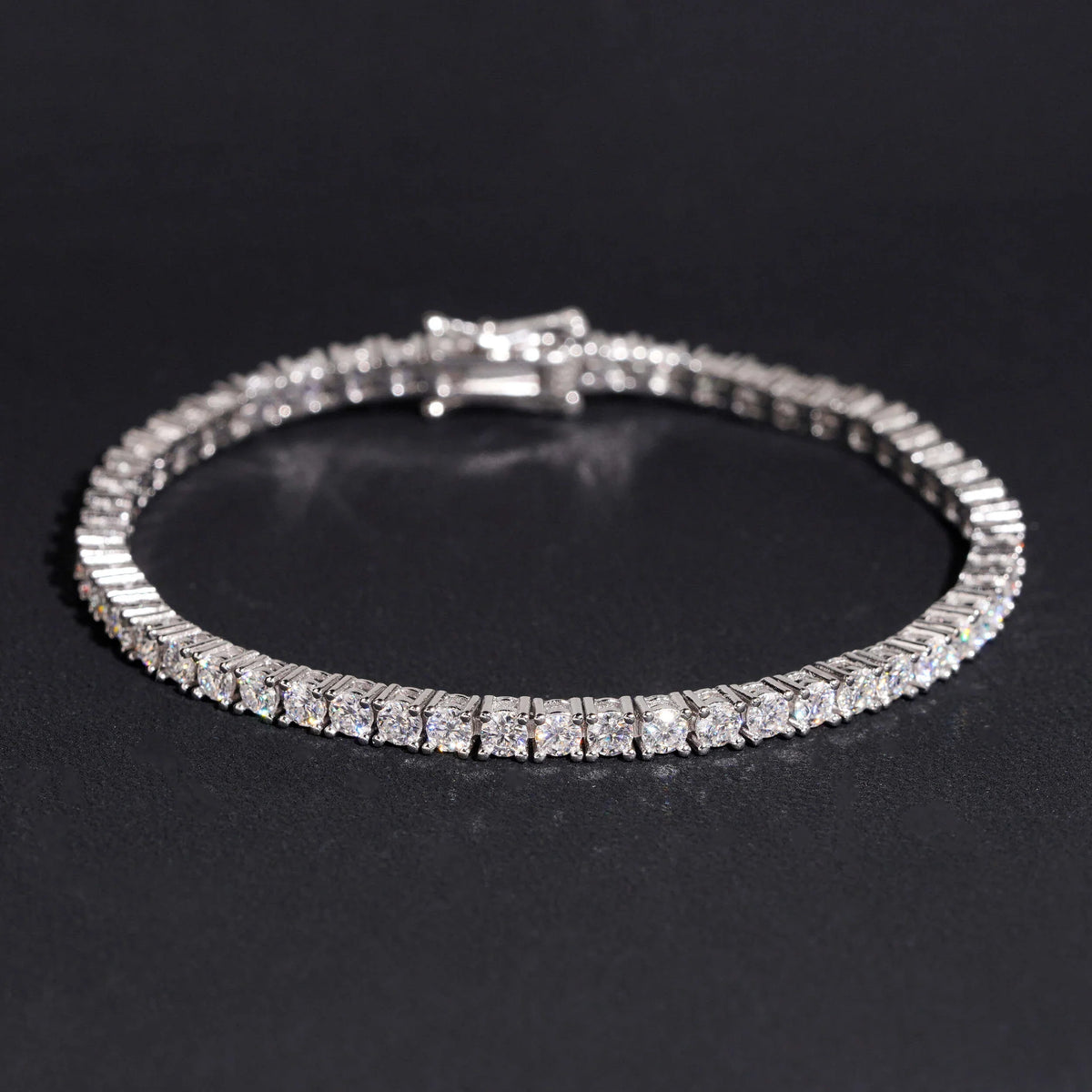
A 26mm Cuban lands on the collarbone like a small padlock; a 2mm tennis row vanishes under a shirt collar. The diamond tester does not care. It reads the stone, and across the moissanite chains, heavy iced-out Cuban links included, it is reading the same stone every time. Press it to a moissanite pendant or a moissanite ring next and the lamp climbs just as high. One answer, whatever it's set in.
That leaves width and length, and that's where most of the deciding actually happens. The Miami Cuban link buyer's guide covers where each width sits on the neck. Rows are a different animal, and the tennis chain and bracelet guide handles those.
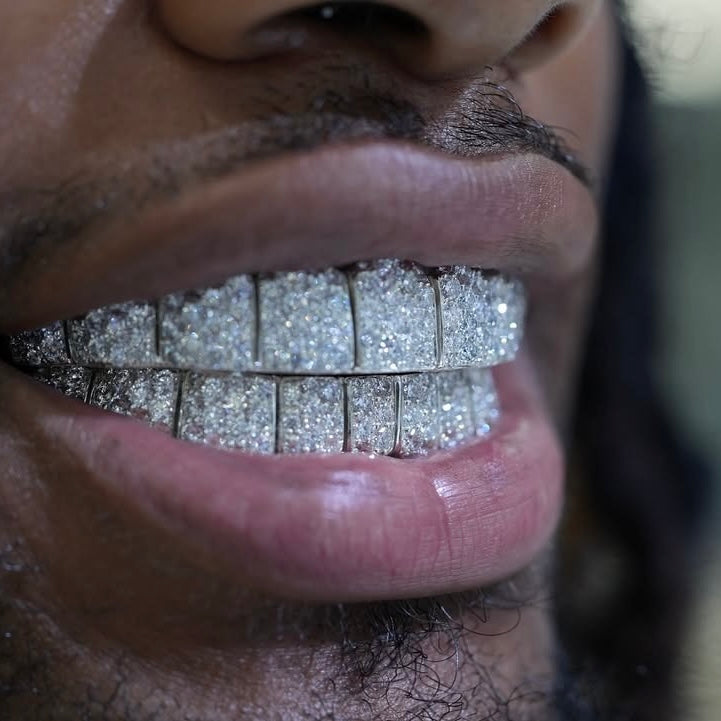
Custom work is priced on coverage. The grillz price guide breaks that down tooth by tooth.
Building something that doesn't exist on the site yet? Bring the shape, the coverage and the metal tone to our custom design page and you'll be quoted on the build rather than handed a range. Where a piece carries a GRA report, that report ships with it, so for most orders the answer to this question is already in the box.
About the author
Iris covers moissanite hip-hop jewelry for CustomHipHop. She works hands-on with the store's certified pieces and the questions buyers ask before and after they order, and checks every claim in this guide against what the store actually stocks and stands behind. Stone properties here were checked against published gemological sources in September 2026, and every external link was status-checked the same day.