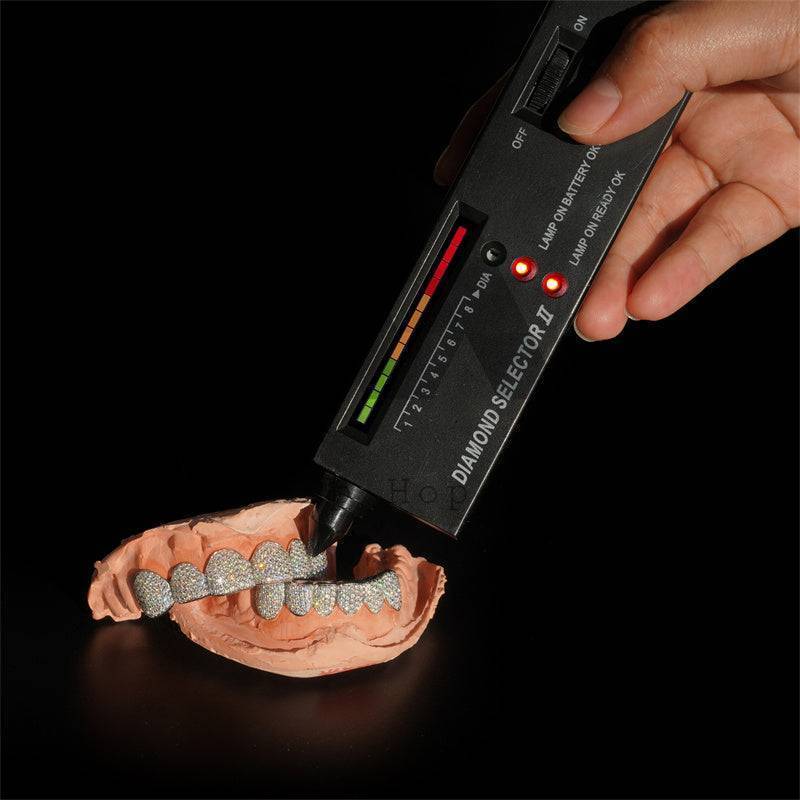


People call moissanite a lab diamond all the time, and it's easy to see why. Both stones are grown in a lab. Only one of them is a diamond, though. A lab grown diamond is carbon, exactly what a mined diamond is made of. Moissanite is silicon carbide, a separate gemstone with its own look. On the same designs in our store, the diamond version costs roughly six to twelve times more.
1. Is Moissanite a Lab Grown Diamond?
No. The mix-up comes from the fact that almost every moissanite on the market today was made in a lab, because the natural kind barely exists. Henri Moissan, a chemist working in France, first found it in 1893, in rock samples from Meteor Crater in Arizona, and at first he thought he was looking at tiny diamonds. It took him until 1904 to pin the crystals down as silicon carbide. The full story is on moissanite's Wikipedia entry.
So "lab-created moissanite" and "lab grown diamond" really do share a birthplace. What grows is different. A lab grown diamond is carbon locked in the diamond crystal, and apart from where it formed, it's the same stone a mine produces. Moissanite is silicon carbide from start to finish. It isn't a watered-down diamond or a copy of one. It's a gemstone in its own right, and it's the stone our main line is built on.
2. What Actually Separates the Two Stones
| Moissanite | Lab grown diamond | |
|---|---|---|
| Made of | Silicon carbide | Carbon, same crystal as a mined diamond |
| Hardness (Mohs) | 9.25 | 10 |
| Refractive index | About 2.65 | 2.42 |
| Fire (dispersion) | 0.104 | 0.044 |
| Basic thermal tester | Reads as diamond | Reads as diamond |
| Conductivity tester | Flags it as moissanite | Reads as diamond |
| How it's graded | On its own scale | On the diamond scale |
Three of those rows matter once the piece is on you. Hardness first: both stones are harder than almost anything you'll knock them against on a normal day, so 9.25 is no reason to baby a chain. Fire is the rainbow flash you get when light splits inside a stone, and moissanite has more than twice as much of it as diamond. That's the biggest visual difference between the two, and section 4 gets into what it looks like in real light.
The tester rows are the ones that catch people out. A basic pen can't separate these two stones at all, which is why we wrote a whole piece on what a diamond tester can and can't prove. For how moissanite stacks up against mined diamond on grading and reports, see the moissanite and diamond comparison.
3. Same Design, Two Stones: What Our Prices Show
Most comparisons you'll find online come from bridal stores, and they stop at one center stone. Iced-out jewelry doesn't work like that. A tennis bracelet or a Cuban link carries dozens of stones, so the gap between the two materials gets paid again on every one of them. We sell several of the same designs in both stones, which makes the difference easy to measure. Here it is in sterling silver, same size, same finish, at our prices in September 2026:
| Design | Size | Moissanite | Lab grown diamond | Gap |
|---|---|---|---|---|
| Solitaire stud earrings, screw back | 5mm stones | $25 | $190 | About 8× |
| Four-prong tennis bracelet | 3mm, 7" | $69 | $840 | About 12× |
| Iced Cuban link bracelet | 10mm, 7" | $238 | $2,610 | About 11× |
| Eternity band | 4mm | $98 | $585 | About 6× |
Two things jump out. The dollar gap climbs with the stone count, from about $165 on a pair of studs to more than $2,300 on a 10mm Cuban bracelet. And the multiple is highest on the full rows, the tennis and Cuban pieces, where nearly every millimeter of the design is stone. Put another way, the money for one 3mm lab grown diamond tennis bracelet here covers a moissanite tennis bracelet and a moissanite Cuban bracelet, with over $500 left. Prices change, so treat this as a snapshot. The live listing always has today's number.


4. How Each One Looks Once It's On
This is where the fire number turns into something you can see. In direct sun, or under the hard spotlights you get in a club, moissanite throws flashes of pink, blue and green. A lab grown diamond sends back more white light and less color. Neither one is better. Plenty of buyers pick moissanite for exactly that rainbow, and some find it a bit much on a big stone.
Stone size decides how much you'll notice. On a large solitaire stud the color shows up close, which is what the first stud photo below catches. On a pavé Cuban link the stones are tiny and packed edge to edge, so the flashes stay small and spread across the whole surface. At arm's length most people just read it as ice. That's one reason moissanite is so common on wide iced-out pieces: its biggest visual tell matters least where it's used most.

Derek P., a verified buyer, got our 13mm iced moissanite Cuban chain in September 2025. His take was simpler: it "shines in the sun and definitely grabs attention." He also mentioned it took about three weeks to make and called it worth the wait.


The two stud photos were taken in different light, so use them to get a feel for each stone's character rather than as a side-by-side test.
5. Which One Fits What You're Buying
Start with the piece, not the stone. If you're after width, coverage and a price you won't think twice about every time you put it on, moissanite is the practical pick. It's how an iced 10mm Cuban bracelet stays an everyday piece instead of one that lives in a safe.
If it matters to you that the stone is a diamond, whether that's for a ring that means something or because you simply want the material itself, go with lab grown. You'll pay for it, and what the money buys is the diamond, not extra sparkle.
One thing we won't sell you on is resale. Neither stone is an investment. Lab grown diamond prices keep sliding as production grows. Wholesale prices fell 26% in 2025 alone, so budget for how a piece looks and wears, not for what it might fetch later.
You also don't have to pick one stone for everything. A moissanite Cuban worn with lab grown diamond studs works fine, and most moissanite designs on the site can be made up in lab grown diamond if you ask through a custom request.
6. Frequently Asked Questions
Which one looks bigger for the money?
Moissanite, by a long way. On the same budget you can go up several millimeters in stone size, or add full rows of coverage. On our 3mm tennis bracelets, one lab grown diamond version costs about as much as twelve moissanite ones.
Can people tell a moissanite chain from a lab grown diamond one?
Not from across a room. Up close and in strong light, someone who knows stones may spot the extra color on larger moissanite, and a conductivity tester will flag it right away. A plain thermal pen won't, since both stones register as diamond on it.
Can I get a moissanite design made with lab grown diamonds instead?
Often, yes. Send us the listing you like and the size you need through a custom build request, and you'll get a price and timing back. Expect a jump like the ones in the table above, because it's the same number of stones in a pricier material.
Why is a lab grown diamond cheaper than a mined one but still pricier than moissanite?
Growing a diamond skips the mine, and that takes a big share of the cost out. It's still diamond, though, graded and sold on the diamond scale, so it sits well above moissanite, a different stone that costs far less to produce.
7. Where the Two Lines Sit in the Store
Tennis rows, Cuban links, studs and bands all come in both stones, so it's easy to compare like with like. For rows, put our moissanite tennis bracelets next to the lab grown tennis bracelets. For wrist weight, the moissanite Cuban bracelets line up against the bracelets in lab grown diamond. Studs split the same way, between moissanite studs and lab grown diamond stud earrings, and the full lab grown diamond line is all in one place.
Sizing a row before you choose the stone? The tennis chain and bracelet sizing guide goes width by width.
About the author
Iris covers moissanite hip-hop jewelry for CustomHipHop and works with both the moissanite and lab grown diamond lines. Every price in this guide was taken from live listings in September 2026, and each pair in the table was checked photo by photo to make sure it's the same design in both stones.